HVAC Insights May 28, 2024

Geothermal Heat Pump vs. Gas Furnace: Which One Should You Install?

Geothermal Heat Pump vs. Gas Furnace: Which Heating System Wins? (2026) | Square HVAC

If you are building a new home or facing a furnace replacement, you have probably heard about geothermal heat pumps. They sound futuristic — using the earth’s stable underground temperature to heat and cool your home. But they also cost significantly more upfront than a traditional gas furnace.

So which is truly better? The answer depends on your property, your budget, your climate, and your long‑term goals.

This guide compares geothermal heat pumps and gas furnaces across every important metric: upfront investment, annual operating costs, lifespan, maintenance, environmental impact, and comfort. By the end, you will know exactly which system fits your home.


The One‑Minute Summary

Gas furnace: Lower upfront cost, works in any climate, simple technology. But you pay monthly for natural gas or propane, and prices fluctuate. Lifespan is roughly 15–20 years with annual maintenance.

Geothermal heat pump: Much higher upfront cost due to ground loop installation. But operating costs can be dramatically lower — often a fraction of gas heating. It also provides air conditioning for free (included in the same system). Lifespan of the ground loop is 50+ years; indoor unit lasts 20–25 years.

The bottom line: If you plan to stay in your home for many years and have suitable land for ground loops, geothermal often pays for itself and then saves thousands. If upfront cost is your primary constraint or you plan to move within a decade, a high‑efficiency gas furnace is the practical choice.


How Each System Works

Gas Furnace

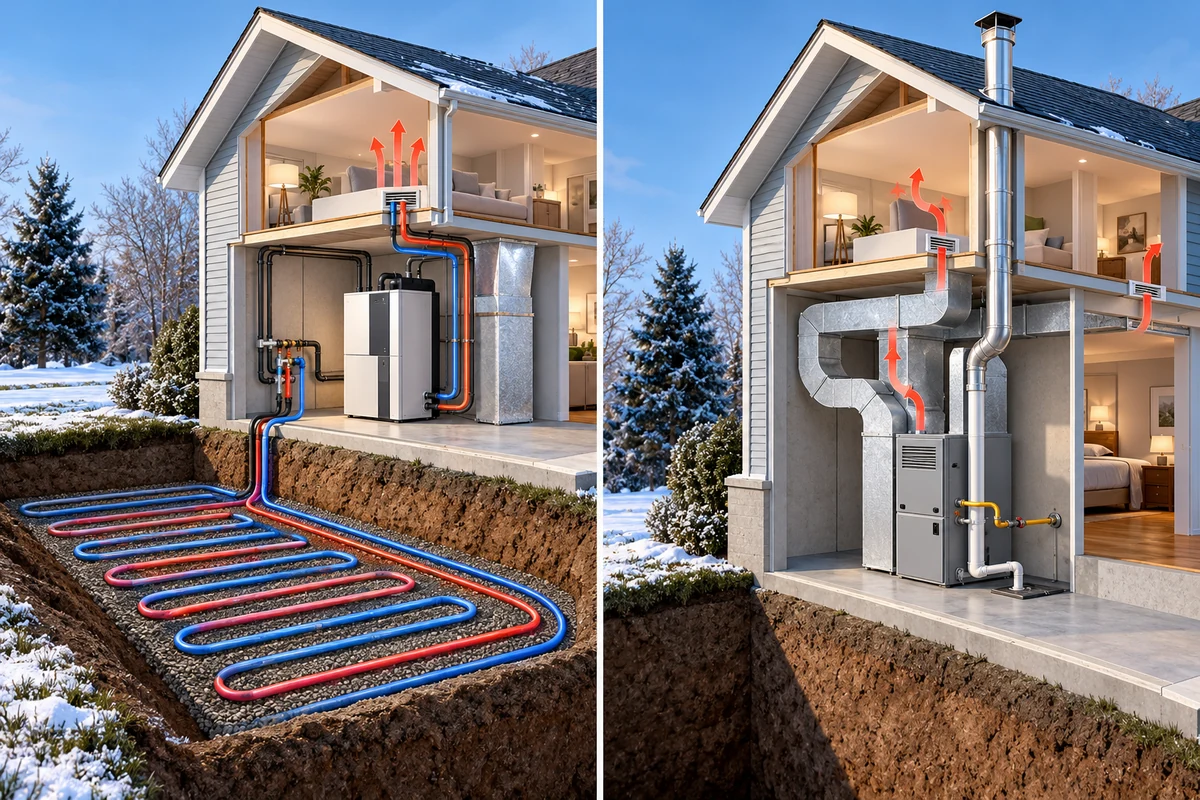
A gas furnace burns natural gas (or propane) to create heat. A heat exchanger transfers that heat to air, and a blower fan pushes the warm air through ductwork into your home. Exhaust gases — including water vapor and carbon dioxide — are vented outside through a flue pipe.

Key components: Burners, heat exchanger, gas valve, igniter, flame sensor, blower motor, flue pipe.

Fuel source: Natural gas from a utility line or propane from a tank.

Geothermal Heat Pump (Ground‑Source)

A geothermal system does not burn anything. It moves heat. In winter, it absorbs heat from the ground (which stays relatively constant at 45–70°F depending on location) and concentrates that heat to warm your home. In summer, the process reverses: it pulls heat from your home and releases it into the ground, providing air conditioning.

Key components: Indoor heat pump unit, ground loop (buried pipes filled with antifreeze solution or refrigerant), circulating pump, ductwork (or hydronic distribution).

Fuel source: Electricity (to run the compressor, pump, and fans). The heat itself comes from the earth.


Side‑by‑Side Comparison

FeatureGas FurnaceGeothermal Heat Pump
Upfront costLower (depends on efficiency and installation factors)Significantly higher (ground loop installation is major expense)
Annual operating costVariable — depends on local gas prices and winter severityVery stable — electricity rates are less volatile than gas
Efficiency80%–98% AFUE (Annual Fuel Utilization Efficiency)300%–600% efficient (delivers 3–6 units of heat per unit of electricity)
Provides cooling?No — requires separate AC systemYes — same system provides both heating and cooling
Lifespan (indoor components)15–20 years20–25 years (ground loop lasts 50+ years)
Maintenance requirementsAnnual tune‑up, filter changes, occasional heat exchanger inspectionAnnual check of refrigerant levels, pumps, and loop pressure; filter changes
Works below freezing?Yes — no performance lossYes — but efficiency drops slightly as ground temperature falls; still works in any climate
Carbon emissionsBurns fossil fuel (natural gas or propane)Uses electricity; emissions depend on your grid’s energy mix
Indoor air qualityGood with proper venting; potential risk of CO if heat exchanger cracksExcellent — no combustion, no CO risk
Space requirementsSmall footprint in basement or utility closetLarge — needs land for horizontal trenches or deep vertical boreholes
Noise levelModerate (blower and combustion noise)Very quiet (similar to a standard heat pump)

Upfront Cost: The Biggest Hurdle

Gas Furnace

Installing a new gas furnace involves:

  • Removing the old furnace
  • Connecting to existing ductwork
  • Running a gas line (if not already present)
  • Venting through a chimney or PVC pipe
  • Electrical connections

Cost determinants: Furnace efficiency (80% vs. 90%+ AFUE), brand, labor rates in your area, and any ductwork modifications needed. A basic replacement costs one amount; a high‑efficiency condensing furnace with new venting costs more.

Geothermal Heat Pump

Installing a geothermal system involves:

  • Ground loop installation — either horizontal trenches (requires significant land area) or vertical boreholes (requires drilling equipment, but less land).
  • Indoor heat pump unit — replaces both furnace and AC.
  • Ductwork — same as a furnace system; if your home already has ducts, they can often be reused.
  • Circulating pump and loop connections.

Cost determinants: Loop type (horizontal vs. vertical), soil conditions, drilling depth, land availability, and the size of your home. Vertical loops are generally more expensive than horizontal due to drilling costs.

Financial help: Geothermal systems qualify for federal tax credits (currently 30% of total cost, no upper limit, through 2032). Many states and utilities offer additional rebates. These incentives can significantly reduce the net upfront cost.

The Net Cost Gap After Incentives

The upfront difference after federal tax credits and local rebates depends entirely on your specific situation. In some cases, geothermal becomes comparable to a high‑end gas furnace + central AC combination. In others, it remains substantially higher. A professional site assessment is the only way to get real numbers for your home.


Operating Cost: Where Geothermal Shines

Gas Furnace Operating Cost

Your monthly heating bill depends on:

  • Local natural gas price (varies by region and season)
  • Furnace efficiency (higher AFUE = lower gas use)
  • Home insulation and size
  • Winter weather severity

Gas prices are historically volatile. A cold winter or supply disruption can spike your bills significantly.

Geothermal Operating Cost

Geothermal systems are remarkably efficient because they move heat instead of creating it. For every unit of electricity used, a geothermal system delivers several units of heat. That translates to much lower energy consumption than even the most efficient gas furnace.

Year‑round savings: Because the same system provides cooling, you also save on air conditioning operating costs. Geothermal cooling is similarly efficient — often cheaper than running a standard AC.

Stability: Electricity prices tend to be more stable than natural gas. And because geothermal uses so little electricity, even large rate increases have a smaller impact on your monthly bill.

Which Saves More Money?

Depends on:

  • Your local gas vs. electricity rates
  • How many heating degree days your climate has
  • Whether you also need a new air conditioner (geothermal replaces both)

In many regions, geothermal operating costs are substantially lower than gas — sometimes by a factor of two or three. But the exact payback period varies. In mild climates with cheap natural gas, the savings may be smaller. In cold climates with expensive propane (not piped natural gas), geothermal can pay for itself quickly.


Lifespan and Long‑Term Value

ComponentGas FurnaceGeothermal
Furnace/heat pump unit15–20 years20–25 years
Ground loopN/A50+ years (often warrantied for 50)
Air conditioner (separate)10–15 yearsNot needed (geothermal does cooling)

If you install geothermal, you are essentially paying once for the ground loop, which will last longer than you own your home. Future replacements require only swapping the indoor heat pump unit — not re‑drilling or re‑trenching.

With a gas furnace, you replace the entire furnace every 15–20 years. You also replace a separate AC every 10–15 years. Over 30 years, that is multiple equipment purchases.


Climate Considerations

Gas Furnace

Works identically in all climates — from Florida to Alaska. No performance degradation in extreme cold.

Geothermal Heat Pump

Also works in all climates, but with caveats:

  • In very cold climates (northern states, Canada), the ground stays cold in winter. The system still works — ground temperatures at depth remain above freezing — but efficiency decreases compared to moderate climates. Oversizing the ground loop compensates for this, but increases upfront cost.
  • In hot climates (southwest, southeast), geothermal cooling excels because the ground is much cooler than outdoor air. Cooling efficiency can be dramatically better than standard AC.

The sweet spot: Homes in climates with both significant heating and cooling loads. Geothermal replaces two systems with one and performs efficiently year‑round.


Environmental Impact

Gas Furnace

  • Burns natural gas or propane — a fossil fuel.
  • Produces carbon dioxide and other combustion byproducts.
  • If vented properly, local air quality is not affected, but greenhouse gas emissions are real.

Geothermal Heat Pump

  • Uses electricity — which may come from fossil fuels, nuclear, or renewables depending on your grid.
  • No on‑site combustion. No carbon monoxide risk.
  • The heat source (the earth) is renewable and endlessly available.

From a pure emissions perspective, geothermal is cleaner in most grids and vastly cleaner if your electricity comes from solar, wind, hydro, or nuclear. Even on a coal‑heavy grid, geothermal often produces fewer emissions than a gas furnace because of its high efficiency.


Maintenance Needs

Gas Furnace

Annual maintenance (recommended):

  • Clean or replace air filter (DIY monthly)
  • Inspect heat exchanger for cracks (critical safety item)
  • Clean flame sensor and burners
  • Check gas pressure
  • Test safety controls
  • Inspect venting and flue

Common repairs: Failed igniter, dirty flame sensor, blower motor failure, cracked heat exchanger (dangerous).

Geothermal Heat Pump

Annual maintenance (recommended):

  • Clean or replace air filter (DIY monthly)
  • Check refrigerant levels
  • Inspect loop pressure and antifreeze concentration (if closed loop)
  • Check circulating pump operation
  • Clean condensate drain
  • Test controls and safeties

Common repairs: Refrigerant leaks (less common than standard AC because indoor unit is protected), pump failure, control board issues.

Geothermal systems have fewer moving parts exposed to weather (the loop is buried). They are generally very reliable, but when repairs are needed, they require specialized technicians.


Which System Is Right for Your Home?

Choose a Gas Furnace If:

  • Your upfront budget cannot accommodate geothermal — even after tax credits.
  • You plan to move within 10 years — you likely will not recoup the investment.
  • You have no suitable land for ground loops (small lot, rocky soil, high water table, protected land).
  • You have existing gas lines and a working gas furnace — a replacement is quick and low‑hassle.
  • You live in a mild climate with cheap natural gas and low cooling needs — the savings from geothermal may be minimal.
  • You prefer simple, familiar technology that any HVAC technician can repair.

Choose a Geothermal Heat Pump If:

  • You plan to stay in your home for 15+ years — long enough to recoup the upfront premium through operating savings.
  • You have suitable land for horizontal trenches or vertical boreholes (a site assessment is required).
  • You want both heating and cooling — geothermal replaces two systems with one.
  • You are building a new home — adding geothermal during construction is much cheaper than retrofitting.
  • You have high energy costs — especially if you heat with propane or oil, not piped natural gas.
  • You prioritize low carbon emissions and energy independence.
  • You want the quietest, most comfortable heating and cooling available — geothermal provides even temperatures without roaring fan noise.

The Hybrid Option: Dual Fuel

You do not have to choose 100% one or the other. A dual‑fuel system combines a gas furnace with an air‑source heat pump (not geothermal). But you can also pair a geothermal system with a small gas furnace for backup — though geothermal rarely needs backup if sized correctly.

The more common hybrid for homeowners on a budget: Install a high‑efficiency gas furnace now, and later add an air‑source heat pump for milder weather, using gas only on very cold days. This is not geothermal, but it offers some efficiency benefits at lower upfront cost.

True geothermal is an all‑in‑one solution. Adding a separate gas furnace is usually redundant.


Common Misconceptions

”Geothermal doesn’t work in cold climates.”

False. Geothermal works in all climates because the ground below the frost line stays relatively warm — typically 45–55°F at depth. Modern systems have been installed successfully in Alaska, Canada, and Scandinavia for decades.

”Geothermal uses too much electricity.”

False. Geothermal uses far less electricity than electric resistance heating (baseboards, space heaters). While it uses more electricity than a gas furnace (which uses almost none), the total energy cost is often lower because of its efficiency.

”Geothermal requires a pond or well.”

False. Most geothermal systems use closed‑loop pipes buried in trenches or boreholes. Ponds and open wells are options but not requirements.

”Gas furnaces are always cheaper to run.”

Not necessarily. If natural gas prices spike or your home is efficient, geothermal can be cheaper. Propane is often much more expensive than piped natural gas, making geothermal very attractive for propane‑heated homes.

”I can install geothermal in any yard.”

Not always. Rocky soil, high bedrock, small lot sizes, or protected wetlands can make installation difficult or impossible. A professional site survey is essential.


Next Steps: How to Decide

  1. Check your current energy costs. Look at your gas and electric bills from last winter. If you use propane, note the price per gallon.
  2. Determine your timeline. How many more years do you plan to live in your home?
  3. Evaluate your land. Do you have space for horizontal trenches (roughly 1,200–1,800 sq ft per ton) or access for a drilling rig for vertical boreholes?
  4. Research incentives. Federal tax credits + state + local utility rebates can change the math dramatically.
  5. Get professional quotes. Hire a geothermal contractor for a site assessment and a detailed cost estimate. Compare against a high‑efficiency gas furnace + AC replacement.

Final Verdict from Square HVAC

The gas furnace is the practical choice for most homeowners today — affordable upfront, widely understood, and backed by a mature service industry.

The geothermal heat pump is the investment choice for homeowners who prioritize long‑term savings, year‑round comfort, energy independence, and environmental responsibility. If you have the land and the budget, geothermal can be one of the smartest home investments you make — especially with current tax credits.

Neither is universally “better.” The right system for your home depends on your unique situation.

Square HVAC can help you evaluate both options. We provide honest assessments, accurate quotes, and professional installation whether you choose a high‑efficiency gas furnace or a geothermal system. Contact us to schedule a consultation.


This guide is for informational purposes. Always consult licensed HVAC professionals for system design and installation specific to your home and local codes.

call