
80% vs 96% AFUE Furnace: Which One Fits Your Building?
An 80% furnace costs less to buy and uses your chimney.
Key points
- Both furnaces heat the building fully; the 96% furnace uses less gas for the same heat.
- A 96% furnace needs plastic vent pipes and a drain — it cannot use the chimney.
- Choose 96% when the building allows the pipes and drain and you will stay for years.
- Choose 80% when venting or draining is the problem, or when you will sell soon.
Both furnaces will keep the building warm. The difference is how much gas they use and how they are installed.
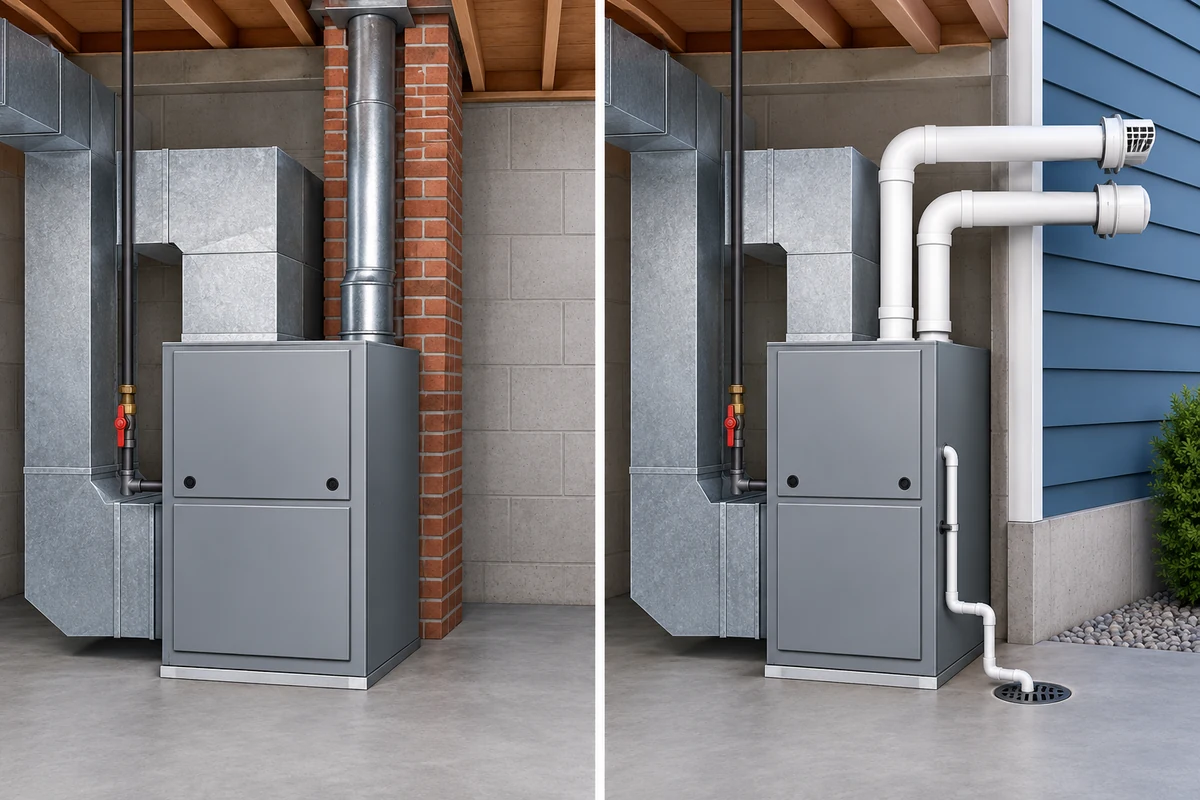
- An 80% furnace costs less to buy. It usually sends its exhaust up the chimney or metal flue you already have.
- A 96% furnace uses less gas for the same heat. It needs plastic vent pipes to the outside and a place to drain water.
The short answer: choose the 96% furnace when the building allows the new vent pipes and a drain and you plan to stay for years. Choose the 80% furnace when venting or draining is the problem, or when you will not own the building long enough to get the difference back. Everything below explains those three points: the pipes, the drain, and the time you will stay.
Compare the ratings you are considering with the Energy Savings Calculator.
Winters around Chicago are long and cold, so a furnace here runs for many months. That is why a 96% furnace is often the better choice over the years, when the building allows the new pipes. Sometimes the building does not allow it, and then an 80% furnace is the sensible answer.
What the number means
AFUE is the efficiency score printed on every furnace. It tells you how much of the gas becomes heat for the building.
- 80% AFUE: out of every 100 units of gas, 80 become heat indoors. The other 20 leave with the exhaust.
- 96% AFUE: out of every 100 units of gas, 96 become heat indoors. Only 4 leave with the exhaust.
The score is on the yellow EnergyGuide label and in the product details.
The two furnaces side by side
| 80% furnace | 96% furnace | |
|---|---|---|
| Gas used for the same heat | More | Less |
| Price to buy | Lower | Higher |
| Exhaust | Hot. Goes up a metal flue or chimney | Cool. Goes out through plastic pipes |
| Water drain | Not needed | Needed |
| Air for the flame | Usually taken from the room | Usually brought in from outside by a pipe |
| Installation work | Often simple, if the old flue is in good shape | More work: new pipes and a drain |
Venting: the part that often decides
An 80% furnace has hot exhaust that rises by itself. It uses a metal flue or a chimney. If the old one is sound and the right size, it can often stay.
A 96% furnace takes so much heat out of the exhaust that the exhaust is only warm. It cannot rise up a chimney. A small fan pushes it out through plastic pipes, usually through an outside wall, sometimes through the roof.
So the first question is practical: is there a good path from the furnace to an outside wall? The pipe ends also need a spot where snow, plants and walkways do not block them.
One thing to check with a 96% furnace. If a gas water heater shares the old chimney, it will be alone in that chimney after the change. The chimney may then need a liner so the water heater still vents safely. The U.S. Department of Energy also advises a chimney check when heating equipment is replaced.
The water drain
A 96% furnace makes water while it runs. This is normal. The water has to go to a floor drain, or a small pump moves it to one.
This matters when the furnace sits in a cold place, such as an attic, a crawl space or an unheated garage. A drain line there can freeze. In those spots an 80% furnace is often the safer choice, unless the drain can be protected.
Comfort
The efficiency number does not decide how comfortable the building feels. Two other features do:
- How the flame works. A basic furnace is either fully on or off. A two-stage furnace has a low and a high setting. A modulating furnace changes in small steps. More steps mean steadier temperatures and longer, quieter runs.
- How the fan works. A variable-speed fan starts gently and moves air more evenly. Rooms feel less drafty.
You can find these features on both kinds of furnace. They are more common on 96% models.
Utility companies sometimes offer rebates for high-efficiency furnaces. Programs and eligibility change, so ask us what is available when you are ready to buy.
For property and business owners
The same choice applies to the furnaces in small offices, shops and apartment buildings. A few extra points:
- Who pays the gas bill. If the tenant pays for gas, the saving goes to the tenant. If the owner pays, the saving goes to the owner. This changes the answer.
- Several units. Each furnace needs its own vent path and drain. In a multi-unit building the pipe ends must also stay clear of windows, doors and walkways.
- Downtime. A like-for-like 80% replacement is usually faster. A change to 96% needs more planning.
For rooftop units and other large equipment, see our commercial page.
What we check before we recommend one
We look at the old furnace, the chimney or flue, the path to an outside wall, the drain, the ducts and the size the building needs. Local rules and the maker’s instructions decide what is allowed in your building, and we check those too. The quote lists parts and labor separately.
Sources
- EPA: R-22 phaseout — homeowners and consumers FAQ · Checked October 2026
- Wikipedia: Annual fuel utilization efficiency (the Department of Energy page was not reachable to automated checks) · Checked October 2026
Need help with this?
Heating InstallationOur heating installation page describes the work and how to book it. We assess the system, explain what we found and provide a written quote for approval before work begins.