
Emergency service 24/7
(708) 673-5633
Call Request service
Guide Updated October 8, 2026

Can Drywall Touch Ductwork? A Homeowner’s Guide

The three things to get right when drywall meets ductwork: condensation, insulation and access.

Key points

  • Check the duct type, insulation, clearance and access before enclosing it.
  • Seal and test the run before the board goes up.
  • In a finished wall, read the signs: stains, musty smell, uneven temperature.

There is no single clearance answer for every duct and wall assembly. Before enclosing ductwork, have the installer check the duct type, insulation, required clearances and service access against the product instructions and local requirements. Do not confuse an air duct with a combustion vent or flue, which has separate clearance requirements.
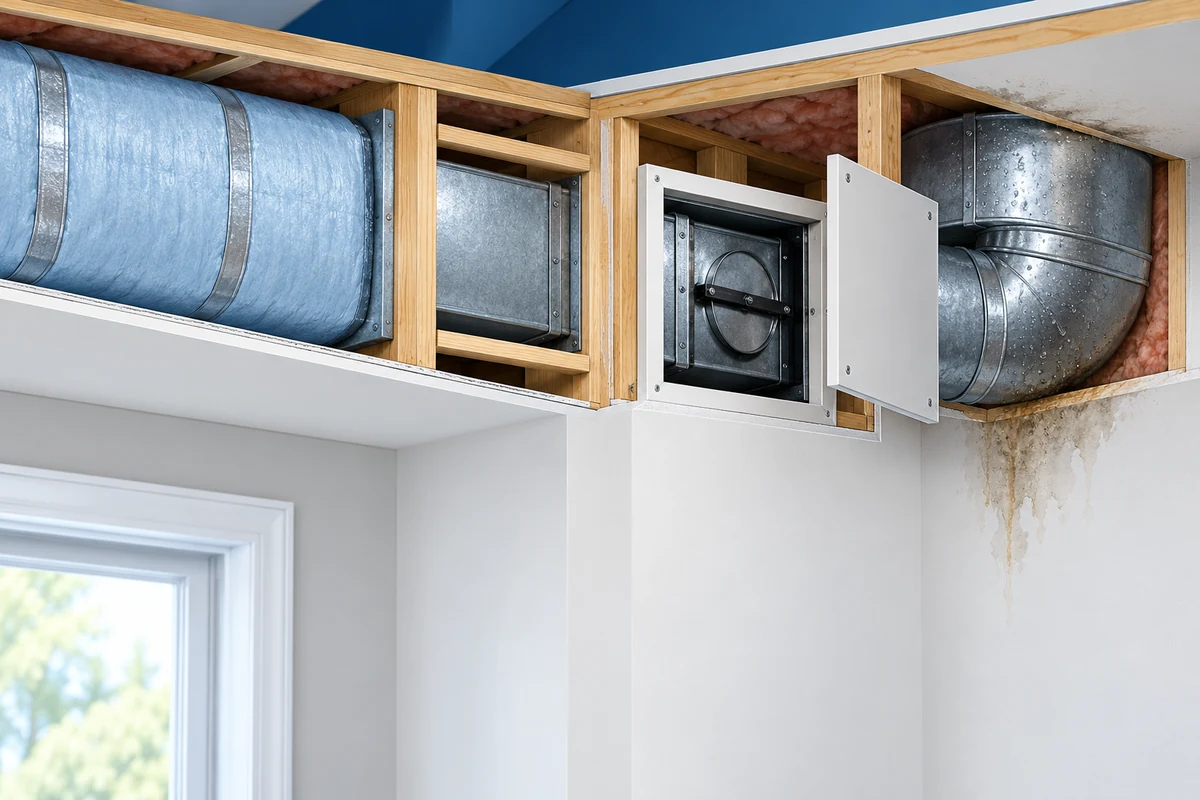
Wall and ceiling cutaway showing insulated ductwork, service access and moisture where a cold bare duct meets drywall
What to notice: Plan for condensation control, insulation and service access before closing the wall. Drywall should not crush the duct or hide a damper or connection that needs service. Conceptual illustration; exact equipment and layout vary.

The three things that matter

1. Condensation

The duct carries cold air in summer. When warm, humid room air touches the cold duct surface, water forms. That water has to be held away from the drywall and the wall cavity, or it wets the material and invites mold.

Suitable duct insulation and a continuous vapor barrier help reduce condensation risk. Humidity, gaps and damaged insulation still matter. Moisture-resistant drywall does not fix a condensation problem or replace duct insulation.

2. Insulation

Insulation also limits unwanted heat transfer. In a hot space, uninsulated ducts can warm cooled air in summer; in a cold space, they can lose heating energy in winter. Have the installer select suitable insulation for runs outside conditioned rooms.

3. Access

Things will eventually need attention: a damper, a junction, a filter box, a leak. If the drywall closes over every access point, the next service visit starts with demolition. Plan removable access panels at junctions, dampers and equipment connections before the wall is closed.

Have a technician look before the wall is opened. Knowing where the leak or condensation sits decides whether the fix is small or a wall and a duct run wide.

Duct and building changes are the part where the duct work and the drywall work have to agree with each other, and with local rules. SquareHVAC handles the duct side, and will tell you plainly which parts belong to the wall contractor.

Sources

Need help with this?

Duct Repair

Our duct repair page describes the work and how to book it. We assess the system, explain what we found and provide a written quote for approval before work begins.


Before you call

Safe checks, and what needs a professional

Signs of a problem behind the wall

If you suspect a problem behind an existing wall, look for the signs

  • water stains or peeling paint below or near ducts;
  • a musty smell in one room or one season;
  • a room that never holds its temperature;
  • a soft or bowed spot where a cold duct runs.

When to call someone who does this work

  • You are finishing a basement or a renovation that encloses ductwork.
  • You see condensation, stains or damp near ducts.
  • You need a duct run moved, and it touches building structure.
  • Rooms have stale air, uneven temperature or a smell that follows the system.

Safe checks you can do yourself

  • Check the thermostat: is it set to heat or cool, and is the set point where you expect?
  • Check the filter: a clogged filter limits airflow. Replace it if it is visibly dirty.
  • Check the power: look at the breaker and the equipment switch near the unit.
  • Check the airflow: hold a hand at a supply register and feel whether air is moving.
  • Check the outdoor unit: clear leaves and debris from around it.

Before the drywall goes up

  1. Step 1

    Seal the ducts first.

    Test the run and seal the joints with mastic or foil tape made for ducts, not cloth duct tape. Any leak you seal now is money and comfort saved for the life of the wall.

  2. Step 2

    Keep access points open.

    Filter slots, dampers, junction boxes and equipment connections need a removable panel, not a permanent lid.

  3. Step 3

    Choose the right board.

    In basements, utility rooms and other damp spaces, moisture-resistant board is the safer choice.

  4. Step 4

    Follow the local rules.

    Clearances from combustible materials, fire-rated assemblies and garage wall requirements vary. Check what your jurisdiction requires and follow it; it is the installer's job to know, not the homeowner's job to guess.

Common questions about drywall and ductwork

Can I drill into drywall where ducts run?
Ordinary screws into studs and drywall are normally fine, but stop when you know a duct, a flexible duct or a refrigerant line runs right behind the surface. When in doubt, check first rather than drilling blind.
Does drywall touching ductwork cause noise?
Contact can transmit vibration or expansion noise. Have the supports and the space around the duct checked; noise alone does not identify the cause.
Should I lower the ceiling below the ducts?
A dropped ceiling below the ducts can add room for insulation and keep the cold duct surface away from the finished ceiling. It is most useful in basements with low ducts and in damp areas.
What about bathroom exhaust ducts behind drywall?
Bathroom exhaust carries moist air. In unheated spaces the moisture can condense against the cold duct. Insulating that run is important, and the details belong in a contractor's plan.
Is spray foam around ductwork a good idea?
Spray foam can insulate and seal in one step, but it can also cover the joints, dampers or access points that service needs. Have an installer plan what stays reachable before anything is foamed in.

Heating and cooling service · Hillside IL

Heating and cooling service in Hillside IL

SquareHVAC repairs, replaces and maintains heating and cooling systems for homes and businesses in Hillside IL and the surrounding communities.

We inspect the equipment, explain what we find and provide a written quote with parts and labor listed separately. You decide if and when the work happens. Serving homeowners and businesses since 2009.

  • Family-owned business
  • Licensed, bonded and insured
  • Serving since 2009