
Can Air Conditioning Make You Cough?
Why air conditioning can make some people cough, the simple things to check, and when a symptom is a question for a doctor rather than an HVAC page.
Key points
- Notice the pattern: the filter, the vent direction, the dryness of the room.
- Fix what is simple and have the system serviced once a year.
- Take a cough that lasts to a doctor rather than to a thermostat setting.
Air conditioning changes the air it moves: it removes heat and also removes moisture, and if the filter or the unit is not cared for, the moving air can carry what collects inside. For some people, that shows up as a dry throat or a cough, especially at night or in a room with a vent blowing straight at the bed.
This page is about the equipment side of that question. It is not medical advice: a cough that continues, or any breathing difficulty, fever, chest pain or blood, is a question for a doctor, not for an HVAC page. Call 911 for severe trouble breathing or severe chest pain. Seek urgent medical advice for coughing up blood. Contact a medical professional when a cough persists, worsens or comes with fever, wheezing or shortness of breath.
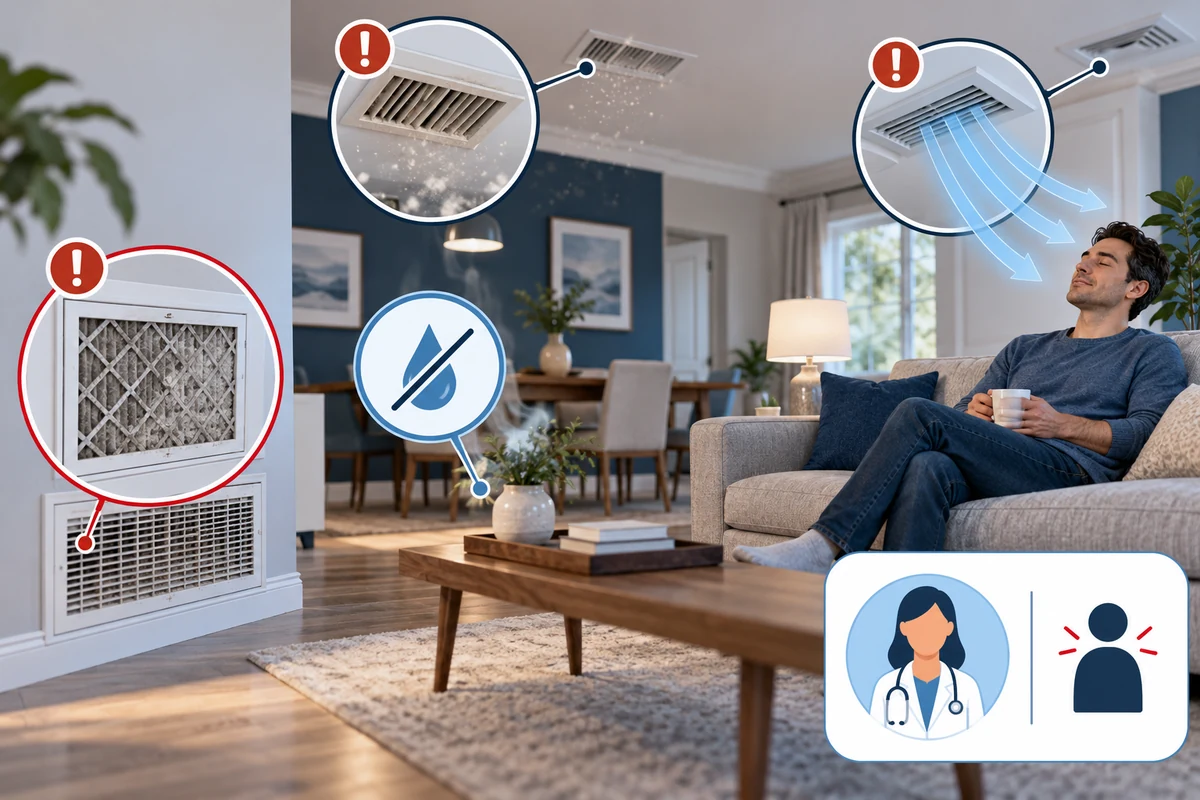
The equipment side: what can make the air feel harsher
1. Dry air
An air conditioner cools by removing moisture, and the longer it runs, the drier the air becomes. Very dry air can feel harsh on the nose and throat, and some people cough in heavily air-conditioned rooms. A setting that does not run constantly, or a humidifier where the air feels very dry, can reduce that effect.
2. A dirty filter
The filter’s job is to catch dust before the dust reaches the equipment. A clogged filter restricts airflow, which can make the system run longer and allow performance and air-quality problems. Our filter guide explains how to check and change it.
3. Dust and moisture inside the unit
The indoor coil makes water as it cools. Over a season, moisture and dust can build up in the drip pan and around the coil. A musty smell from the vents is the usual sign. The yearly service visit cleans these parts.
4. The vent aimed at you
A vent that blows cold, dry air straight at a chair or a bed exposes one person to more of that air than anyone else. Redirecting the vent or the seating is the simplest fix of all.
5. Refrigerant and the outdoor unit
A low refrigerant charge or a blocked outdoor unit does not poison the air, but it makes the system run longer and its coils go colder, which makes icing and moisture problems worse. These faults belong to a licensed technician.
If symptoms appear mainly in one building and improve when you leave it, have the system checked — and still tell the doctor everything, because the two answers work together.
Sources
- EPA: Care for Your Air — a guide to indoor air quality · Checked October 2026
Need help with this?
Air Conditioning ServiceOur air conditioning service page describes the work and how to book it. We assess the system, explain what we found and provide a written quote for approval before work begins.