4 Blinks on Furnace: What It Means and How to Fix It
You walk downstairs to check your furnace and see a red LED blinking four times, pausing, then blinking four times again. That pattern is your furnace’s built-in diagnostic system telling you exactly what’s wrong. 4 blinks on a furnace means the high limit switch is open—a safety device has detected conditions that could cause overheating and has shut the system down to protect your home .
This guide explains what the 4-blink error code means, why it happens, how to troubleshoot it safely, and when you need a professional.
What Does 4 Blinks Mean on a Furnace?
On nearly every major furnace brand—Goodman, York, American Standard, Carrier, Trane, and others—4 blinks (or 4 flashes) indicates an open high limit switch . The high limit switch is a critical safety device that monitors the temperature inside the furnace. When it gets too hot, the switch opens (breaks the electrical circuit), shutting off the burners to prevent overheating, fire, or damage to the heat exchanger .
The exact wording varies by manufacturer:
| Brand | Error Code Wording |
|---|---|
| Goodman | ”Open High Limit Switch” |
| York | ”Limit Switch Open” (red) or “Y preset with no G call” (amber) |
| American Standard | ”Open High Limit Device” |
| ICP / Heil / Tempstar | ”Limit Circuit Fault” |
| Most others | ”Open Limit” or “Limit Circuit Lockout” |
Important: Some brands use different codes. Always check the diagnostic chart on the inside of your furnace’s blower door or front panel. But across the industry, 4 blinks most commonly points to the high limit switch .
What Is the High Limit Switch?
The high limit switch is a temperature-activated safety switch mounted above the burners, inside the furnace cabinet. Its job is simple but vital:
- Normally closed: Allows the furnace to operate when temperatures are safe.
- Opens on overheat: When the furnace gets too hot (typically 150°F–200°F depending on the model), the switch opens, cutting power to the gas valve and burners.
- Auto-resets: Most high limit switches reset automatically once the furnace cools down—usually within 5–15 minutes .
- Manual-reset variants: Flame rollout switches and some blocked vent switches require a manual button press to reset .
If the switch opens repeatedly or stays open longer than 3 minutes, the control board may enter a limit circuit lockout, where the blower runs continuously but the burners stay off .
Why Is the High Limit Switch Open? Common Causes
The high limit switch is doing its job when it trips. The real problem is whatever is causing the furnace to overheat. Here are the most common causes, ranked by how often they occur :
1. Dirty or Clogged Air Filter (Most Common)
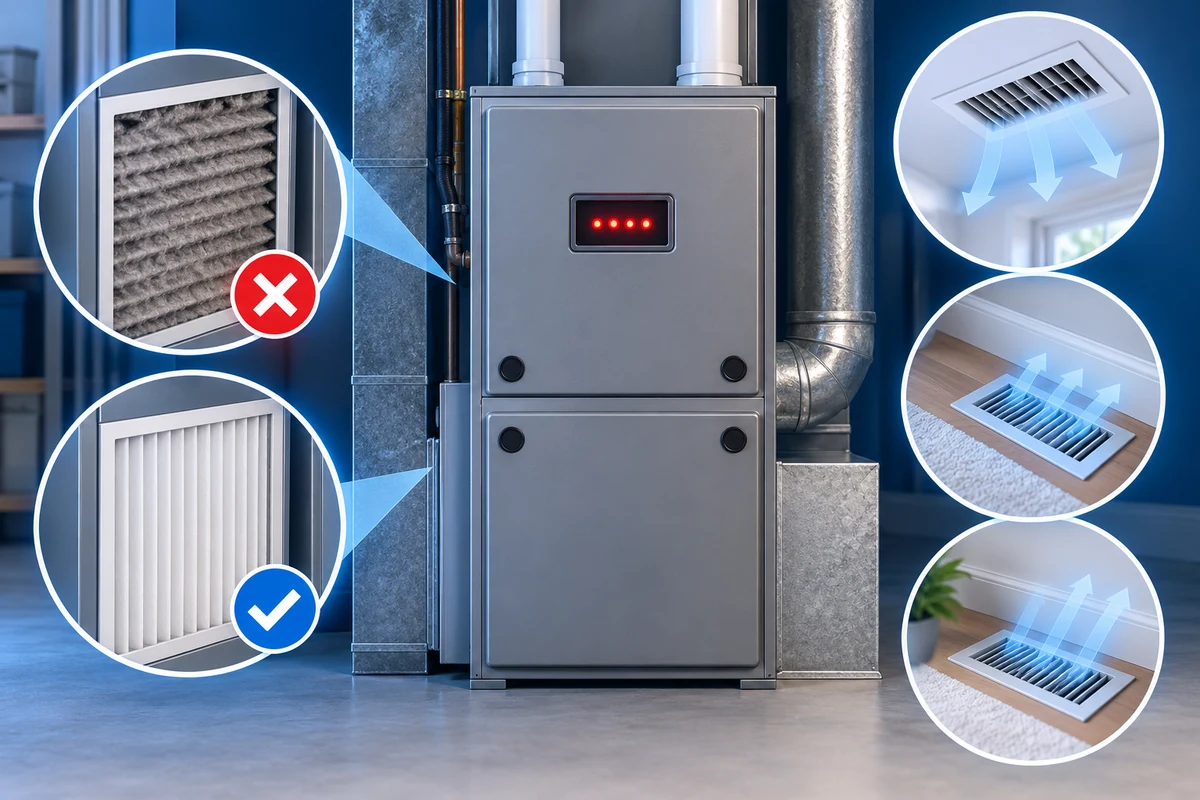
A blocked air filter restricts airflow through the furnace. With less air moving across the heat exchanger, heat builds up, temperatures rise, and the limit switch trips .
Fix: Replace the filter immediately. If you’ve been running the same filter for months, this is almost certainly your problem.
2. Blocked or Closed Vents and Registers
Closing too many vents, blocking them with furniture or rugs, or shutting off entire rooms reduces the total airflow the furnace needs to stay cool .
Fix: Open all vents and registers. Ensure nothing is blocking return air grilles.
3. Dirty Blower Wheel or Evaporator Coil
Dust buildup on the blower wheel or a clogged AC evaporator coil (which sits above the furnace in most setups) acts like insulation, choking airflow .
Fix: Clean the blower wheel and evaporator coil. This usually requires a technician.
4. Loose or Slipping Blower Wheel
If the blower wheel is loose on the motor shaft, it won’t spin at full speed, reducing airflow .
Fix: Tighten the set screw on the blower wheel or replace it if damaged.
5. Defective Blower Motor or Capacitor
A weak blower motor or a failing run capacitor can’t push enough air. One homeowner traced their 4-blink code to an exploded capacitor that was causing the blower to run weakly, eventually overheating the furnace .
Fix: Test the capacitor with a multimeter (should read within ±10% of its rated microfarads). Replace if weak. If the motor itself is failing, it needs replacement.
6. Restricted or Undersized Ductwork
Ducts that are too small, crushed, or internally blocked create backpressure, slowing airflow .
Fix: Have a professional inspect duct sizing and condition.
7. Blocked Flue or Exhaust Vent
A blocked vent pipe traps combustion gases, raising temperatures inside the furnace .
Fix: Inspect the vent pipe for debris, bird nests, or ice blockages. Check the termination cap outside.
8. Furnace Overfiring (Too Much Gas)
If the gas valve is delivering more fuel than the burner orifices are designed for, the furnace produces more heat than the blower can remove .
Fix: A technician must clock the gas meter and adjust the manifold pressure.
9. Defective Limit Switch (Rare)
The switch itself can fail—especially in hot attics where it sits unused all summer . But most of the time, the switch is fine and the root cause is airflow .
Fix: Test for continuity across the switch when the furnace is cool. If it’s open when cold, replace it.
10. Inadequate Combustion Air Supply
If the furnace room is sealed too tightly, the burners can’t get enough fresh air, causing flame rollout that trips rollout switches .
Fix: Ensure combustion air vents are open and unobstructed.
Step-by-Step Troubleshooting: 4 Blinks on Furnace
Follow this checklist in order. Turn off power to the furnace at the breaker before doing any hands-on work.
Step 1: Check the Air Filter
- Remove the filter.
- If it’s gray, clogged, or you can’t see light through it, replace it.
- Wait 5–10 minutes for the furnace to cool, then power it back on.
- If the 4 blinks disappear, the filter was the culprit.
Step 2: Open All Vents and Registers
- Walk through your home and make sure every supply and return vent is fully open.
- Move furniture, rugs, or curtains blocking airflow.
Step 3: Inspect the Blower Wheel
- Remove the blower compartment door.
- Look at the blower wheel. Is it caked with dust? Is it loose on the shaft?
- Spin it by hand—it should turn freely without wobbling.
Step 4: Check for a Manual Reset Switch
Some furnaces have multiple limit switches:
- High limit switch — Auto-reset, mounted above burners.
- Flame rollout switches — Manual reset, small red button between the wires, located near the burner opening .
- Blocked vent switch — Manual reset, sometimes mounted on the exhaust pipe outside the furnace .
If any of these have a red button, press it firmly until you hear a click. If it clicks, it was tripped.
Warning: If a flame rollout switch trips, do not simply reset it and walk away. Rollout switches trip because flames are escaping the burner box—this is a serious safety hazard. Call a technician immediately .
Step 5: Test the Limit Switch with a Multimeter
- Turn off power.
- Locate the high limit switch (usually a small rectangular or round device with two wires, mounted above the burners).
- Remove the wires and set your multimeter to continuity or resistance (Ω).
- Cold furnace: Should show continuity (0 Ω or beep). If it reads open (OL / infinite), the switch is bad and needs replacement .
- Hot furnace: Will read open until it cools. Wait 15 minutes and retest.
Step 6: Test the Capacitor and Blower Motor
- The run capacitor is a cylindrical or oval component near the blower motor.
- Discharge it safely, then test with a multimeter set to capacitance.
- Compare the reading to the rating printed on the capacitor (e.g., 10 µF ±5%).
- A reading outside the tolerance means replacement is needed .
Step 7: Check for Blocked Exhaust Vent
- Go outside and look at the vent termination.
- Clear snow, ice, leaves, or nests.
- If you suspect internal blockage, a technician can run a camera or pressure test.
Step 8: Reset the Furnace
- Turn off power at the breaker for 5–10 minutes .
- Restore power and observe.
- If the 4 blinks return immediately and the furnace is cold, the limit switch circuit is open electrically (bad switch, loose wire, or control board issue).
When to Call a Professional
Some 4-blink situations are safe to troubleshoot yourself. Others require a licensed HVAC technician:
| Safe DIY | Call a Pro |
|---|---|
| Dirty air filter | Gas valve overfiring |
| Closed vents | Cracked heat exchanger |
| Resetting a tripped switch (once) | Repeated rollout switch trips |
| Basic capacitor test | Internal ductwork blockage |
| Cleaning external vent cap | Control board failure |
| Blower motor replacement |
Call a professional immediately if:
- The flame rollout switch trips more than once.
- You smell gas or burning.
- The furnace runs but the blower never starts.
- You’re not comfortable working with gas or electrical components.
How Much Does It Cost to Fix?
| Repair | DIY Cost | Professional Cost |
|---|---|---|
| Air filter replacement | $10–$30 | $0 (you do it) |
| High limit switch | $15–$40 | $150–$300 |
| Run capacitor | $10–$25 | $150–$250 |
| Blower motor | $100–$300 | $400–$800 |
| Control board | $100–$400 | $500–$1,200 |
| Ductwork repair | N/A | $300–$2,000+ |
One homeowner was quoted $549 to replace a high limit switch and over $3,000 for additional parts. After DIY troubleshooting, they discovered a dusty fuse connection was the real cause—and fixed it in 15 minutes for under $40 in parts . Always do basic checks before accepting a major repair quote.
Preventing 4 Blinks in the Future
- Change your air filter every 1–3 months during heating season.
- Keep all vents open—closing vents does not save money; it overheats your furnace.
- Schedule annual maintenance—a technician will clean the blower, check the limit switch, test the capacitor, and inspect the heat exchanger.
- Keep the area around your furnace clear—combustion air and return air need unrestricted flow.
- Check your exhaust vent seasonally—especially after storms or heavy snow.
Frequently Asked Questions
What does 4 blinks on a furnace mean?
4 blinks means the high limit switch is open. The furnace has overheated and shut itself down as a safety measure .
Can I reset a high limit switch myself?
Most high limit switches reset automatically when the furnace cools. Manual-reset switches (flame rollout, blocked vent) have a red button you can press once. If it trips again, call a technician .
Why does my furnace blink 4 times but then work fine later?
The limit switch may be opening intermittently during longer heating cycles. This usually means restricted airflow (dirty filter, weak blower) or the switch is weakening. Don’t ignore it—it will get worse .
Is 4 blinks always the high limit switch?
On most brands, yes. However, some manufacturers use different codes. York uses 4 amber blinks for a different issue (Y preset with no G call) . Always verify against your furnace’s specific diagnostic chart.
Can a dirty filter really cause 4 blinks?
Yes. A clogged filter is the #1 cause of high limit trips. It’s also the cheapest and easiest fix .
What if the limit switch tests good but I still get 4 blinks?
Check the wiring between the switch and the control board for loose or corroded connections. If wiring is good, the control board may be misreading the signal .
How long should I wait for the furnace to cool before resetting?
Wait at least 5–10 minutes after turning off power. The high limit switch needs time to cool and close .
Bottom Line
4 blinks on your furnace is a safety signal, not a random glitch. The high limit switch has detected overheating and shut the system down to protect your home. In most cases, the fix is simple: replace a dirty filter, open closed vents, or reset a tripped switch. But if the problem keeps coming back, deeper issues like a failing blower motor, blocked ductwork, or an overfiring gas valve need professional attention.
Never bypass or jumper the high limit switch permanently—that removes a critical safety layer and creates a fire hazard. Fix the root cause, and your furnace will run safely and efficiently all winter.
Related: delta t in hvac